CH32V003 - What's That?

Shade

Hm?
What's this?
...A microcontroller?
Yeah, but look at the price
Only ten cents?
That's... suspiciously cheap. I've used Arduino boards, ESP8266, ESP32. But I've never heard of this one
So?
So I guess I'll have to find out what it is
Okay. It's a CH32V003, made by WCH
It's a 32-bit microcontroller based on WCH's QingKe RISC-V2A core. It can run at up to 48 MHz, has 16 KB of Flash and 2 KB of SRAM, and supports 3.3 V or 5 V operation
So basically a tiny computer
Technically, yes
While looking into it, I found this EEVblog video
The more I looked at the chip, the more interesting it became
It's obviously not going to replace an ESP32. Two kilobytes of RAM is laughably small compared to what I'm used to
You say that like two kilobytes isn't enough to run an entire civilization
The point is that the CH32V003 isn't trying to be an ESP32 It's an extremely inexpensive general-purpose MCU
If all you need is some GPIO, a timer, an ADC, a serial interface, or a small control program, you don't necessarily need a much more powerful chip.
Look!
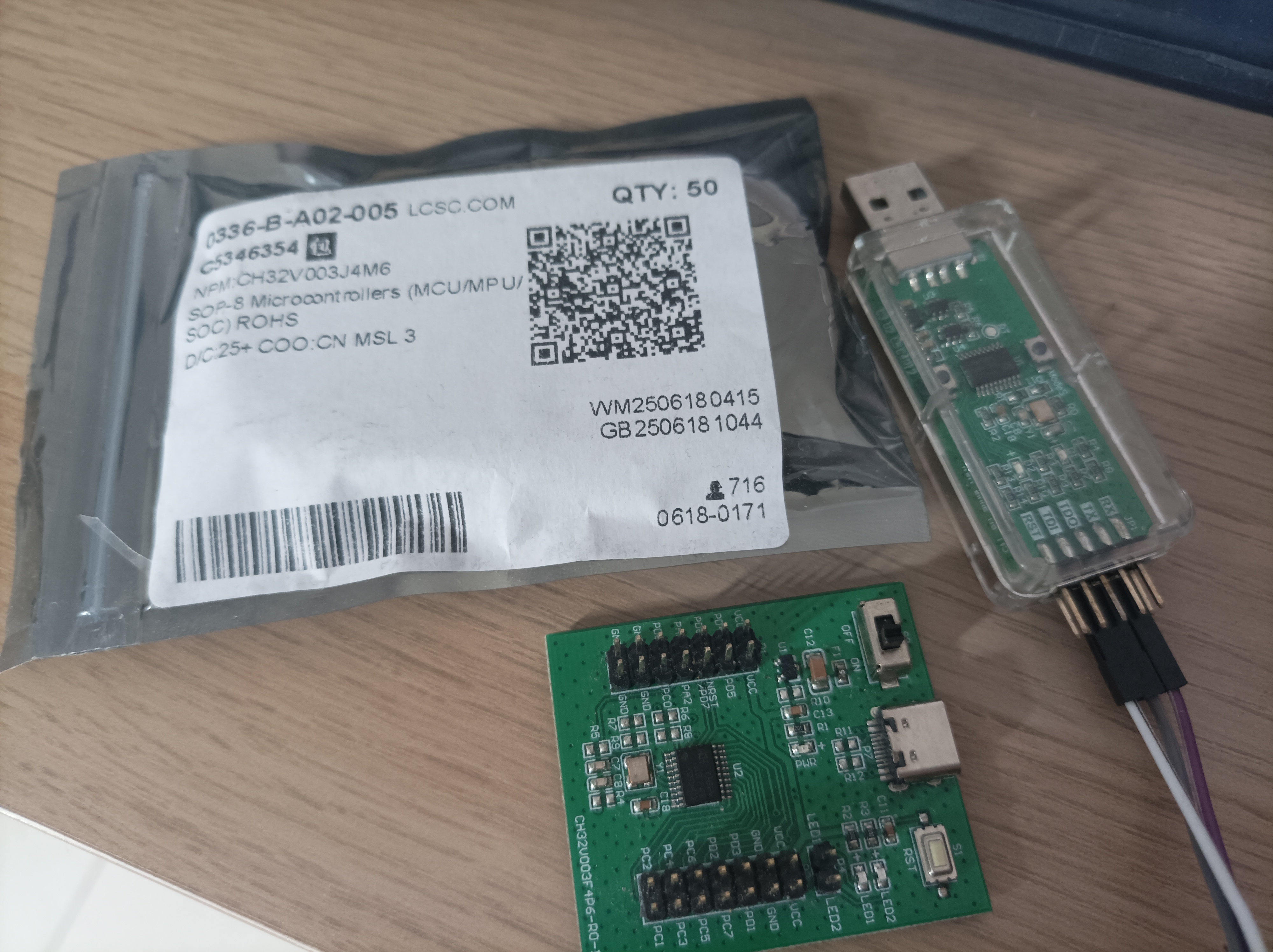
So you bought one
Yes
Of course you did
Unlike the Arduino ecosystem I'm used to, I couldn't just plug the board in, open Arduino IDE, select a board, and immediately press upload
So we need another IDE
And another programmer
And another utility
After installing the necessary tools and getting the WCH-LinkE recognized, I created a simple project in MounRiver Studio.
Shade· c#include "debug.h"
#define LED_PIN GPIO_Pin_6
#define LED_PORT GPIOD
void GPIO_Config(void)
{
GPIO_InitTypeDef GPIO_InitStructure = {0};
RCC_APB2PeriphClockCmd(RCC_APB2Periph_GPIOD, ENABLE);
GPIO_InitStructure.GPIO_Pin = LED_PIN;
GPIO_InitStructure.GPIO_Mode = GPIO_Mode_Out_PP;
GPIO_InitStructure.GPIO_Speed = GPIO_Speed_50MHz;
GPIO_Init(LED_PORT, &GPIO_InitStructure);
}
int main(void)
{
SystemCoreClockUpdate();
Delay_Init();
GPIO_Config();
while (1)
{
GPIO_SetBits(LED_PORT, LED_PIN);
Delay_Ms(500);
GPIO_ResetBits(LED_PORT, LED_PIN);
Delay_Ms(500);
}
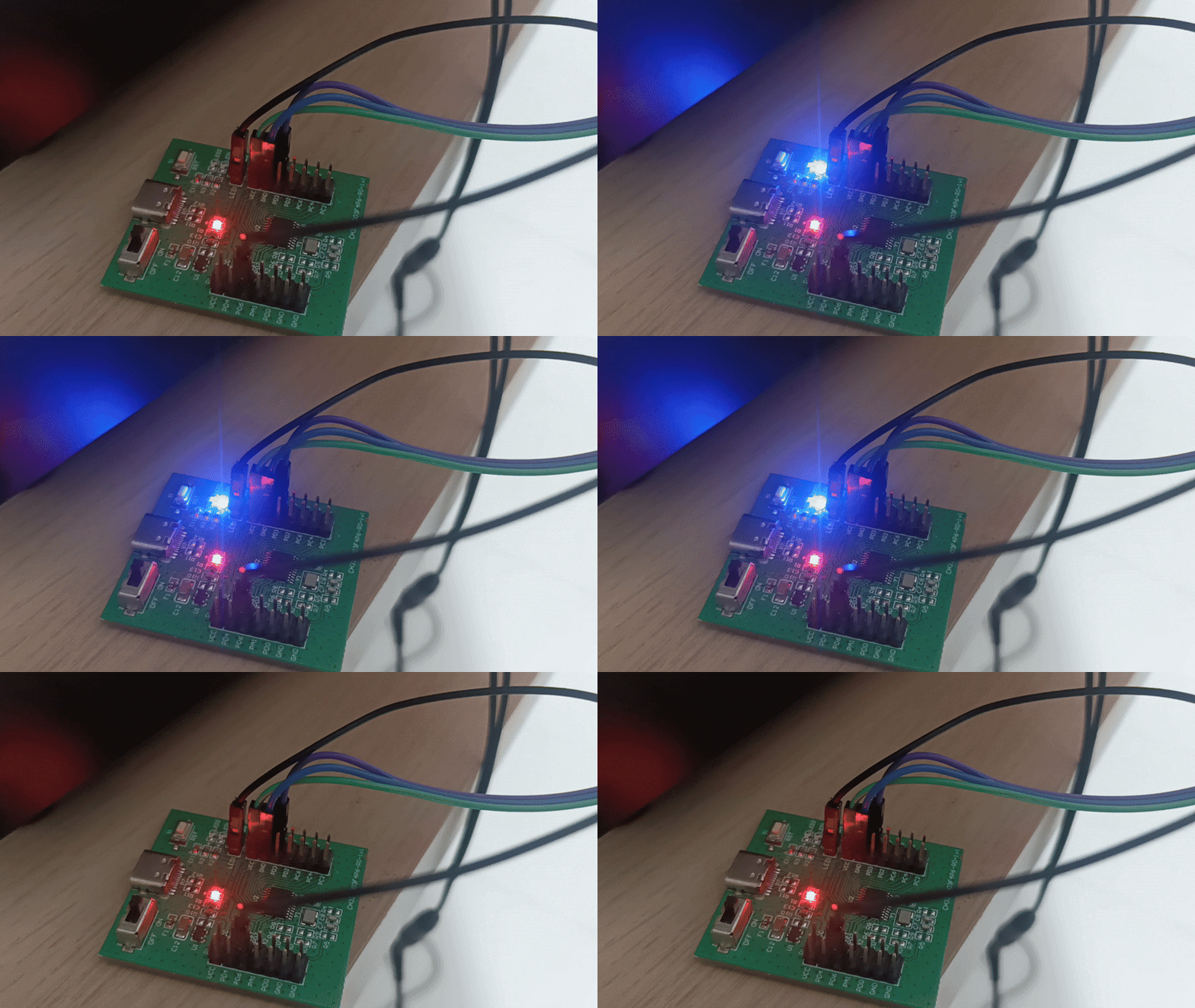
}Look, the LED is blinking
So... what are we building with it?
I don't know yet
Then I have an idea