RISC-V-RISU

Shade

What?
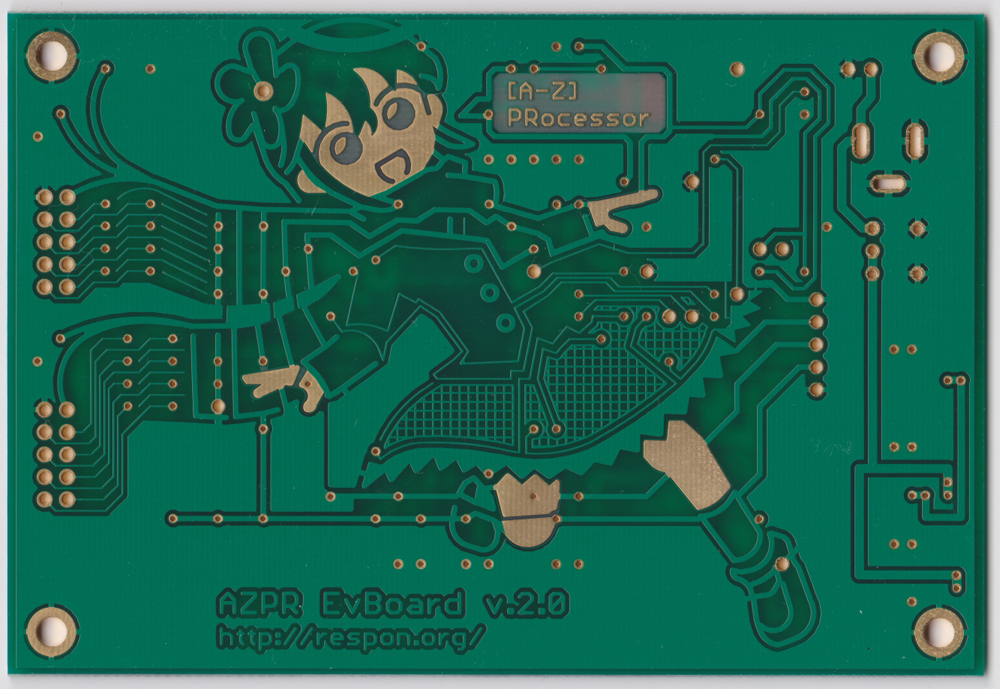
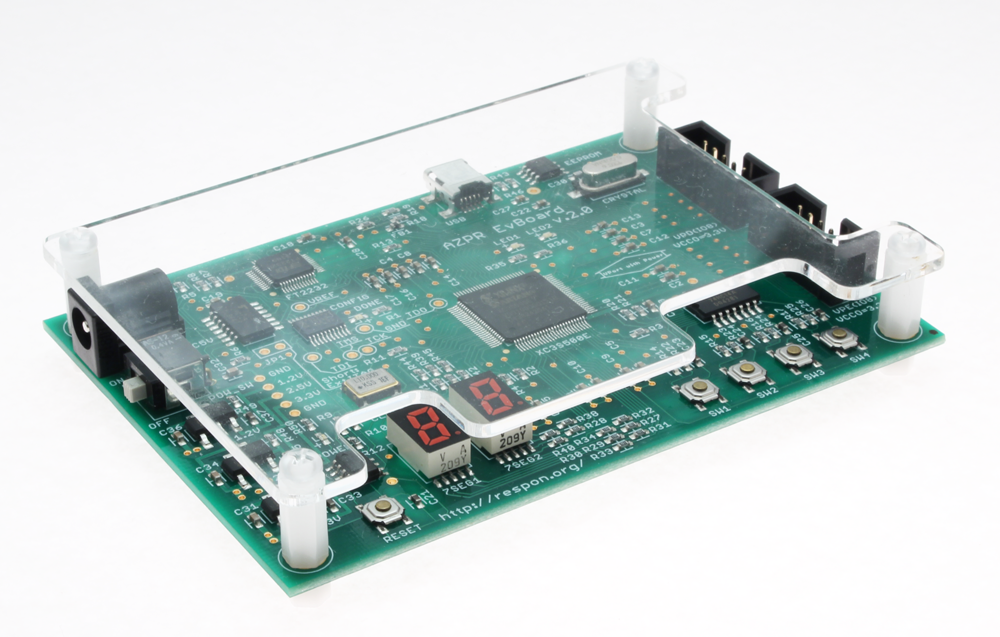
Wow... Is that an FPGA board?
Yes
And there's a girl drawn on the PCB... using the traces
That's actually pretty cool
Right?!
I found this while going down another internet rabbit hole. Apparently there's this thing called 同人ハード, or doujin hardware
Doujin as in independent or fan-made?
Pretty much. Doujin literally has a much broader meaning, but in this context it's basically hardware made by independent creators or small circles, rather than a conventional commercial product
So... indie hardware
Exactly
Looking into the AZPR EvBoard, it's actually a proper FPGA development board. The artwork isn't just decoration slapped onto the board—the PCB traces themselves form the illustration on the back. The board was designed around an FPGA and was also intended for experimentation with things like designing and running your own CPU.
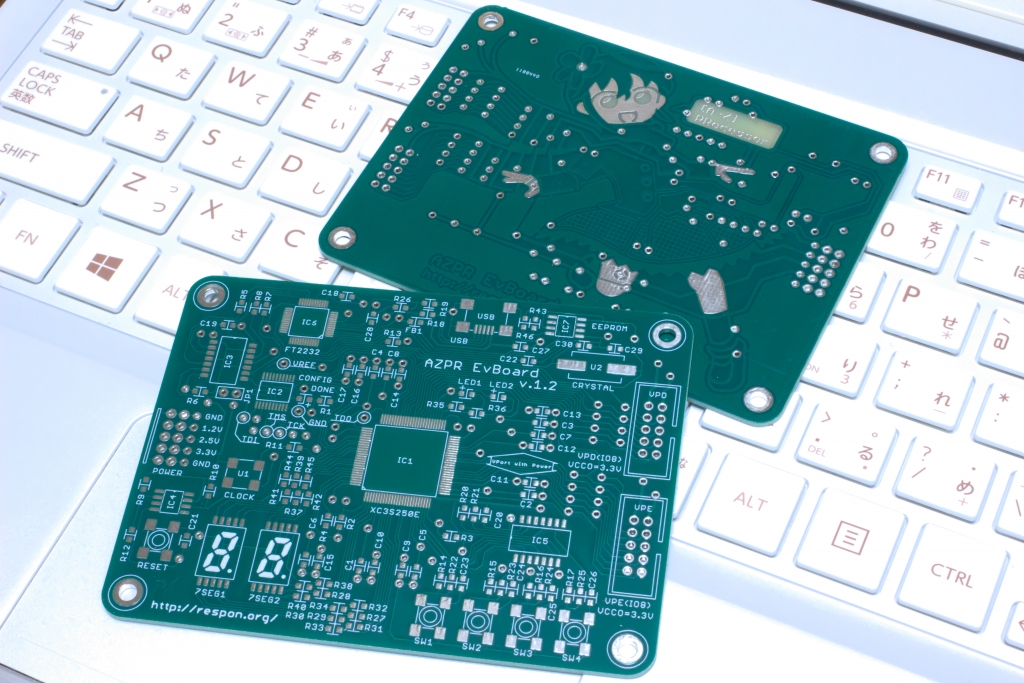
So it's not just a pretty PCB
No. It's an actual FPGA development board
Have you used FPGA before?
A little. I used them at university for a few months. Enough to know my way around one, write some HDL, and make digital logic work
So you're an FPGA expert?
Absolutely not
Using an FPGA for a few months doesn't make me an FPGA expert
Okay, so we're making one
No
Why not?

Because designing an FPGA board is considerably more complicated than drawing a cute picture on a PCB
But the picture is the important part
It is not
Okay, what if we make something simpler? Something we can actually build
Like?
A cool PCB
...
Fine. Something useful
Such as?
A keychain
...
A really cool keychain
That's considerably more achievable
And we already have a microcontroller
The CH32V003
So we're putting a RISC-V microcontroller on a keychain
Now you're getting it
The basic idea is actually pretty simple. We'll use the CH32V003 as the brain. It's a tiny RISC-V microcontroller with 16 KB of Flash, 2 KB of SRAM, and a 48 MHz maximum clock.
And what exactly is it going to do?
Make noise
Perfect
More specifically, we'll use a small electromagnetic buzzer. There's also a push button, a CR2032 coin-cell battery, and a small transistor circuit to control the power
Transistor circuit... for what? Why not just connect the battery to the microcontroller and use the button as an input?
Because then the microcontroller would have to remain powered all the time, consuming the battery
Oh
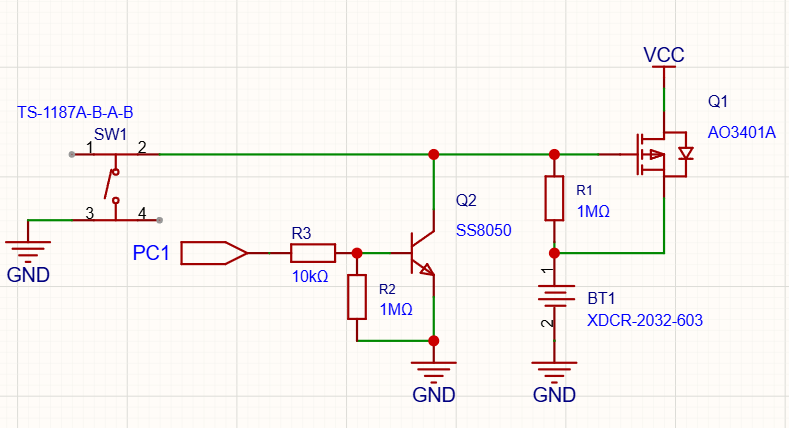
Instead, we're going to use a latching power circuit
A Tiny Power Trick The basic idea is that the button briefly turns the circuit on. Once the CH32V003 starts running, it controls the transistor circuit so that it keeps itself powered. The circuit uses two transistors, an SS8050 and an AO3401A to create a simple electronic latch. Think of it like a physical light switch, except instead of your finger keeping the switch in position, a tiny amount of current from the circuit keeps the switch on. Q: How does it turn off? A: The MCU releases the latch. Once the transistor circuit is no longer being held on, the battery is disconnected from the rest of the circuit.
That's actually pretty cool
That's why we don't need a traditional power switch
And the buzzer?
That's connected to another GPIO. The CH32V003 can toggle the GPIO rapidly, which lets us drive the buzzer at different frequencies
So we can play music?
Very loosely
It's not going to replace a speaker, it only beeps
That's fine
While you are doing all the boring engineering stuff, I had an extremely important job
Artwork
You mean you were drawing
Yes
See? I have a role in this project
...
I never said you didn't
Once the schematic was complete, the PCB was designed around it. The board needed to fit everything into a small enough shape to work as an actual keychain, while still leaving enough room for the components and the artwork. The final design contains: - CH32V003J4M6 RISC-V MCU - CR2032 battery - Push button - SS8050 + AO3401A power latch - Electromagnetic buzzer - Supporting resistors and capacitors - Programming connections for the WCH-LinkE
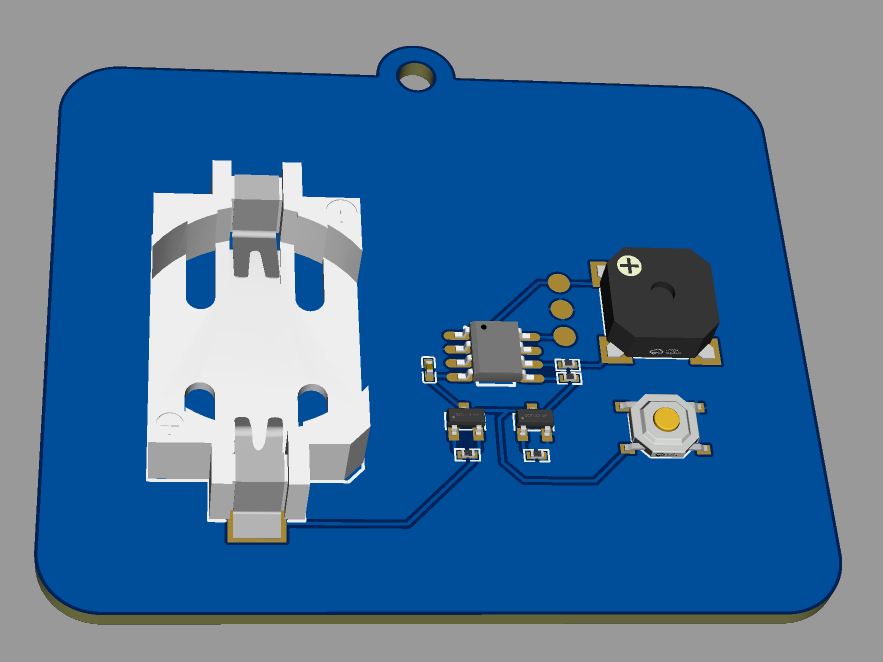
That took me hours to design
And most importantly...
Yea?
The artwork!

You forgot her tail btw...
Yea, I just realized it after exporting it. Whatever... It’s too late to change it now
Anyway, a normal PCB is usually green, right?
Not necessarily
There are multiple choices of color, like red, blue, yellow, etc But this one is special, I ordered it from JLCPCB with a white solder mask and multicolor silkscreen, which makes the artwork much more visible… and, of course, more colorful
From JLCPCB?
Yes
Are they sponsoring us?
No
JLCPCB, if you're reading this...
They're not sponsoring us
I didn't even finish
I know where this is going
...please sponsor us
A Few Weeks Later...
It's here!
Finally!
Look at it!
The silkscreen actually came out pretty well
The next step was assembly. There's something oddly satisfying about taking a completely empty PCB and slowly turning it into an actual circuit. First the smaller components. Then the transistors. Then the microcontroller. Then the buzzer. Finally, the battery holder and button. After soldering everything together and flashing the firmware, it was time for the moment of truth.
Does it work?
Let's find out!
IT WORKS!
We made a keychain with a RISC-V processor
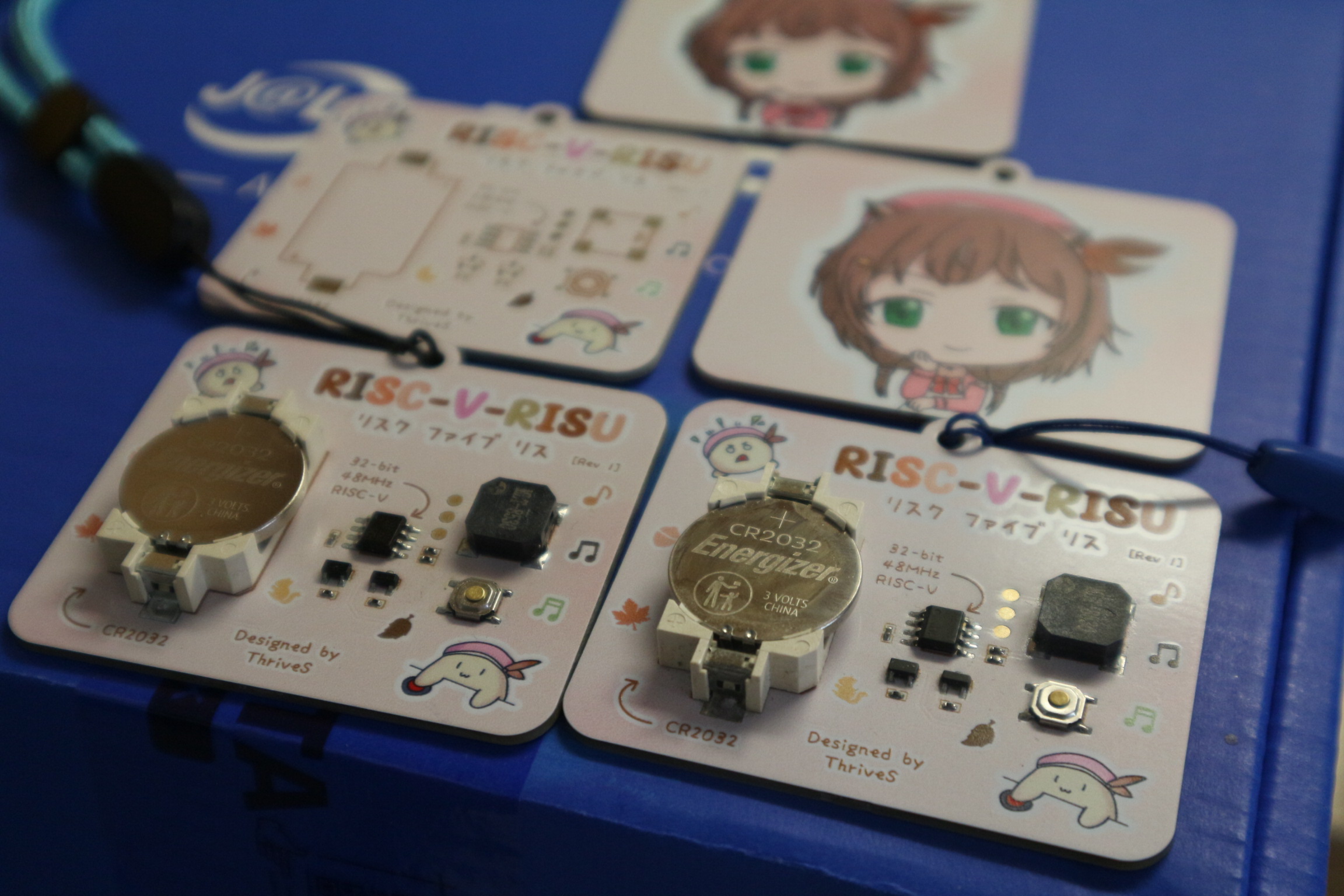
Technically, yes
The project started with a simple video about a ten-cent microcontroller. From there, the exploration led to a Japanese FPGA board featuring an anime girl drawn directly into its PCB traces, which introduced the concept of doujin hardware. Inspired by the idea, the decision was made to create a piece of hardware, eventually resulting in RISC-V-RISU: a tiny PCB keychain featuring custom artwork of Ayunda Risu from Hololive ID, a CH32V003 RISC-V microcontroller, a transistor-based power latch, and a buzzer. What began as an excuse to make a cool PCB turned into a surprisingly educational project. The CH32V003 handles most of the logic, while the surrounding circuitry turns it into a functional little gadget. A button and transistor-based latch handle power, while a GPIO controls the buzzer. The microcontroller can run its program, generate tones, and eventually release the latch to shut itself down.
You don't always need a complicated project to learn something. Sometimes you just need an excuse to put a microcontroller on something that absolutely didn't need one
Like a keychain
Exactly
And if anyone wants to make one... The hardware design and firmware are available here:
https://github.com/ThriveShadow/risc-v-risu
This is perhaps the most interesting lesson from this project: The fun part isn't always building something powerful. Sometimes it's seeing how much you can do with something tiny.